



Mosaics are ancient, beautiful, and can be used to bring classical-era design and art into the modern home – in this article we’re going to tell you a little bit more about mosaics, where they originate from, and everything you need to know when considering a purchase.
The Origin of Mosaic
The first examples of what we call Mosaic can be traced as far back as the 4th century BC in Mesopotamia[1]. Almost two and a half millennia ago. Various examples have been found in classical era cultures including Macedonia[2], Greece[3] and Albania[4].
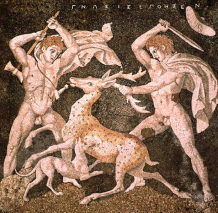
1 Stag Hunt Mosaic from the House of the Abduction of Helen at Pella, ancient Macedonia, late 4th century BC
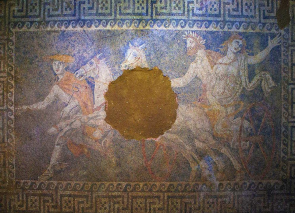
2. A mosaic of the Kasta Tomb in Amphipolis depicting the abduction of Persephone by Pluto, 4th century BC
These early works were mainly constructed using coloured pebbles, but as methods became more advanced through the centuries – strong and robust, mosaics could be applied to huge surfaces without losing any integrity. That’s the reason that the beautiful art of mosaic has remained contemporary throughout all of recorded history.
Things to consider when planning a mosaic wall covering:
This is more of a useful checklist for you to think about. Get pen and paper (or notepad.exe) in front of you and keep the tab open while you think of the following:
1. Where is it going? Bathroom, kitchen, maybe even a steam room or sauna?
2.How big is the space? Not only will that dictate cost and installation time, but also – are there opportunities for bespoke art? An ultimate expression of a special space.
3. What ‘vibe’ are you going for? Airy, luxurious, or utility? (such as splashback mosaic in a kitchen or non-slip flooring in a wetroom.
4. What’s your budget? Bigger budgets offer greater options, so make sure you know how much resource you can invest into a great project!
From the Earth to Mosaics
All mosaic tiles come from mother earth, some of the most popular are Marble, and Travertine, a form of limestone.
Travertine
– Travertine enjoys a great variety of natural colours, particularly low-key ones ideal for relaxation areas. Some examples include Cream, Ivory and Noce.
– Every tile is unique, due to deposits of organic matter from trees and leaves left during formation. Over time these materials rot and evaporate, creating slight voids perfect to give natural authenticity to piece in an overly synthetic world.
– Very affordable and available in a variety of finishes – tumbled, chiselled, polished and more – depending on what you’re after!
Marble
– Luxurious and incredibly elegant, marble has been a material of choice since the classical era. Natural marble is white, any veins of colouring are caused by mineral impurities – making each tile unique!
– The crystals inherently found in marble can refract light several millimetres beneath the surface – giving light, depth and that signature glistening.
– Like Travertine, Marble is porous, so must be properly sealed and tested to be water-tight.
Expertly Crafted Man-Made Mosaic Tiles
Ceramics
– Expertly engineered ceramics are superb insulators for both heat and moisture, making them an ideal choice for bathrooms, steam rooms and pools.
– They are most often cheaper than mined materials (such as marble), meaning that larger, more intricate projects can be achieved for the same budget.
– A wide variety of colours and material blends are available, allowing for great flexibility and creativity in designing your new space.
Glass
– Glass tiling is perhaps the most popular choice for luxury pool and spa spaces, owing to the tremendous customisation options and beautiful finishing.
– Light refraction within the tiles themselves creates beautiful light-shows across the visible light spectrum, perfect for accentuating and complementing natural reflections from water.
– Colour-backings including gold, silver and bronze allow for limitless shading options, as well as epoxy additives in the tiles themselves to customise reflectivity and refraction.
– We recommend SICIS as a preferred and trusted supplier for glass mosaic tiles.
Need guidance?
Aegean Spas have been studying and embracing ancient styles and methods to create amazing spaces for wellness and relaxation. If you’re considering a mosaic project, get it touch.
Sources
[1] http://www.iranchamber.com/art/articles/tile_history1.php | Retrieved 13/08/19
[2] Capizzi, Padre (1989). Piazza Armerina: The Mosaics and Morgantina. International Specialized Book Service Inc
[3] Dunbabin, Katherine M. D. (1999). Mosaics of the Greek and Roman World. Cambridge University Press. ISBN 978-0-521-00230-1.
[4] Ibid. Piazza Armerina: The Mosaics and Morgantina